Small Wedding Checklist: What Changes at 50 Guests or Fewer
A small wedding checklist for weddings of 50 guests or fewer, built around the four numbers that actually change: catering count, venue size, vendor minimums and seating.
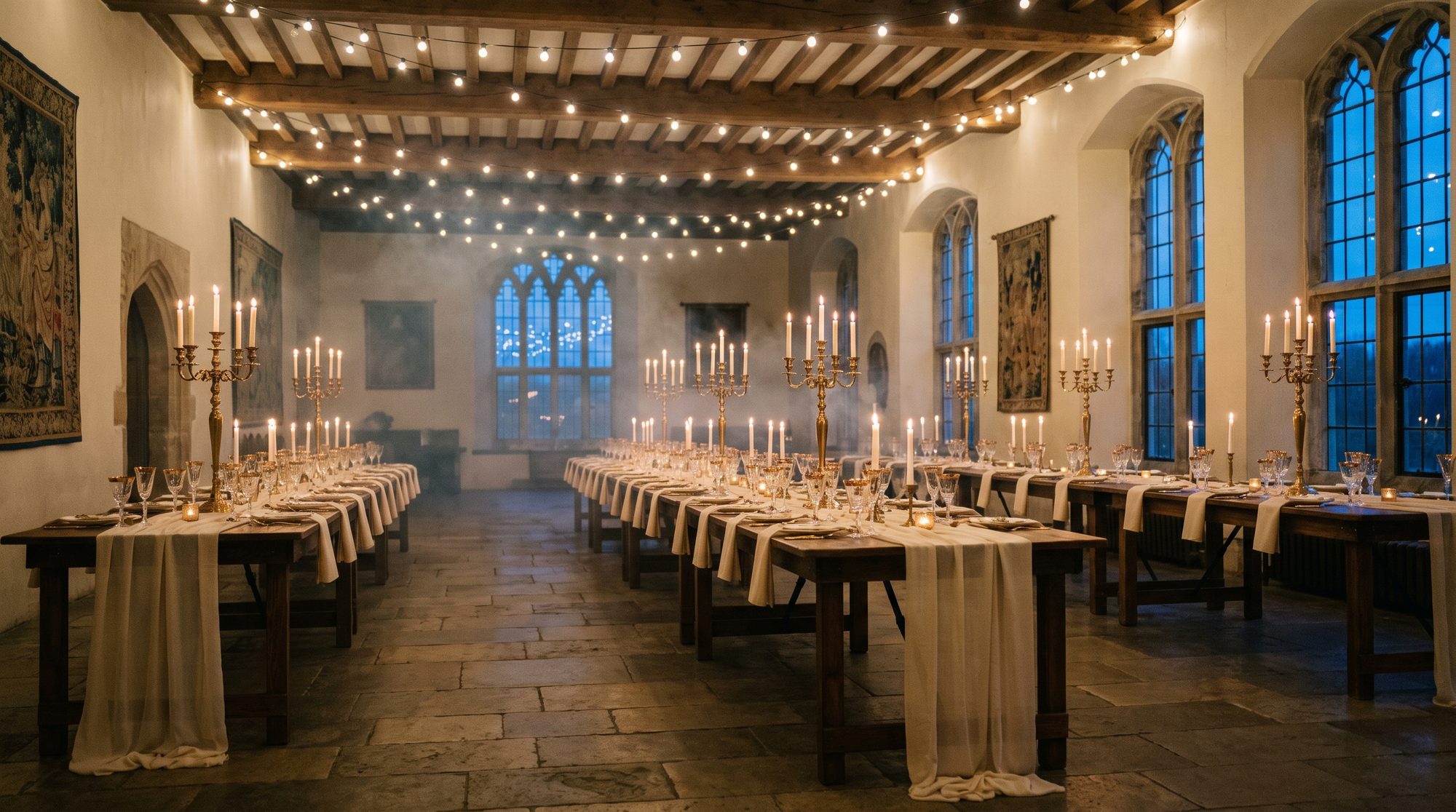
A small wedding checklist starts with one number: $17,100, the average cost of a US wedding with 50 guests or fewer, against $43,300 once the guest list passes 100.1 The legal steps and the scheduling logic on this checklist are the same as any wedding's. Four numbers underneath them change instead: catering count, venue size, vendor minimums, and seating.
Everything else on a full wedding checklist still applies at this size. What follows is the version scaled for 50 guests or fewer, in the order the numbers actually get decided.
What actually changes below 50 guests
Nothing about the paperwork gets smaller with the guest count. The notice period, the vendor contracts, the ceremony script: identical at 30 guests or 300. What shrinks is everything that scales with headcount.
Four line items move with guest count and nothing else: how much catering costs, what size venue you actually need, whether vendors will take the booking at all, and how much seating logic you have to plan around. A venue built for 150 does not rent for less because 40 people are coming, and some vendors set a minimum headcount or minimum spend that a small guest list has to clear before they will quote at all. Ask about both minimums before booking anything.
Some of that works in your favor. A shorter guest list means fewer catering covers, a smaller room to search for, and less coordination overhead across vendors on the day itself. None of it means less planning depth on the parts of the checklist that do not scale with headcount: the notice period, the vendor contracts, and the ceremony script all still need the same attention they would at any size.
The cost gap by guest count
| Guest count | Average total cost |
|---|---|
| 1-50 | $17,100 |
| 51-100 | $27,200 |
| 100+ | $43,300 |
The Knot's own size breakdown puts a 50-guest-or-fewer wedding at $17,100 on average, a 51-to-100-guest wedding at $27,200, and anything over 100 guests at $43,300.1 The gap between the smallest tier and the largest is close to $26,000, and almost none of it is the ceremony. It is catering covers, rental capacity, and the vendor list scaling with the room.
Phase 1: Set the guest list before anything else
Every other number on this checklist is downstream of one decision: who is actually coming. Catering counts, seating logic, and venue capacity all get quoted against a guest list, not against a vague idea of "small." Lock the list first, even in draft form, before calling a single venue.
A useful floor to work from: the national average cost per guest is $292.1 That number does not change because the wedding is small; it is what one seat costs to feed, however many seats there are.
Two versions of the same guest list are worth writing down before you call anyone: the list you would invite with no budget limit, and the list you would keep if the budget got cut in half. The gap between the two tells you whether "small wedding" means a genuinely intimate day by choice, or a budget constraint dressed up as a style preference. Both are legitimate reasons to plan for 50 guests or fewer; they just lead to different conversations with a venue about whether the guest count is fixed or still negotiable.
Phase 2: Choose a venue sized for the day, not the season
Venues built for 150-guest receptions are not automatically cheaper at 40 guests, and some carry a minimum spend that assumes a larger room is being filled. Ask two questions on every venue call before anything else: the guest minimum for the date you want, and whether the room has a smaller configuration for your actual count. A room that photographs half-empty is its own problem, separate from price.
Smaller venue formats are worth asking about by name rather than waiting for a venue to offer them: a private dining room instead of a ballroom, a restaurant buyout instead of a dedicated event space, a backyard or a public garden with a permit instead of a purpose-built venue. None of these show up on a standard venue shortlist search, because most venue marketing is built around the larger reception, not the smaller one. Asking the direct question, "what's the smallest guest count you'll book for this date," filters out venues that would otherwise waste a tour.
Phase 3: Catering and budget for a smaller table
Catering is where the guest-count math becomes a real dollar figure, and it is worth running before you commit to a headcount you cannot afford to feed.
Take a 40-guest small wedding as a worked example. At the national average of $292 per guest, catering alone runs about $11,680.1 That is the same per-guest rate a 150-guest wedding pays; the only variable that changed is how many times it gets multiplied. Knowing the rate before the guest list is final is what keeps a "small and simple" wedding from becoming a large bill with a short guest list.
Phase 4: Seating gets simpler, so use it
A guest list under 50 is small enough that allocated seating stops being a logistics project and becomes a short list you can hold in your head, or better, in one shared plan everyone involved can see. This is the phase where a smaller wedding actually saves planning time, not just money.
Phase 5: Build the day-of schedule
The schedule itself does not get simpler at 40 guests, it gets shorter to build. PlannedBy's run sheet generator derives every downstream time from one input, the ceremony time, whether the day serves 40 guests or 400.
For a 3:00 PM ceremony at 40 guests, that looks like: getting ready from noon, ceremony at 3:00, photos from 3:30, reception from 5:00. Move the ceremony time and every other row shifts with it, the same as it would for a larger wedding with more vendors on the same rail. DIY pricing on PlannedBy is a single payment for the whole wedding, not a per-guest or per-vendor charge, so a shorter guest list does not change what the schedule itself costs to build.
Frequently asked questions about small weddings
How many guests count as a small wedding?
Most cost and venue data treats 50 guests or fewer as the small-wedding tier, distinct from the 51-to-100 and 100-plus tiers that carry higher average costs.1
Is a small wedding actually cheaper per guest?
No. The national average cost per guest is $292 regardless of guest count.1 A small wedding costs less overall because it multiplies that rate by a smaller number, not because the rate itself drops.
Do venues charge less for fewer guests?
Not automatically. Many venues carry a minimum spend or minimum headcount tied to the room, not the guest list, so a small wedding can still be quoted against a large-room minimum. Ask for both figures before booking.
Does a small wedding still need a day-of schedule?
Yes. Vendors, family, and the venue still need to be in the same place at the same time, and a schedule derived from the ceremony time works the same way at 40 guests as it does at 400.
What should be finalized first on a small wedding checklist?
The guest list. Catering counts, seating, and venue capacity are all quoted against it, so an unfinished list stalls every other decision on this checklist.
This checklist is not for an elopement, where the guest list is effectively zero and the legal minimum is the entire plan, or for a wedding already past 100 guests, where the venue, catering, and vendor numbers on this page no longer apply. Both of those get their own version of this checklist, built around what actually changes at that size.