What Time Should My Wedding Ceremony Start?
What time should my wedding ceremony start? About three hours before sunset on your own date, with a typed end time so the night still finishes on time.
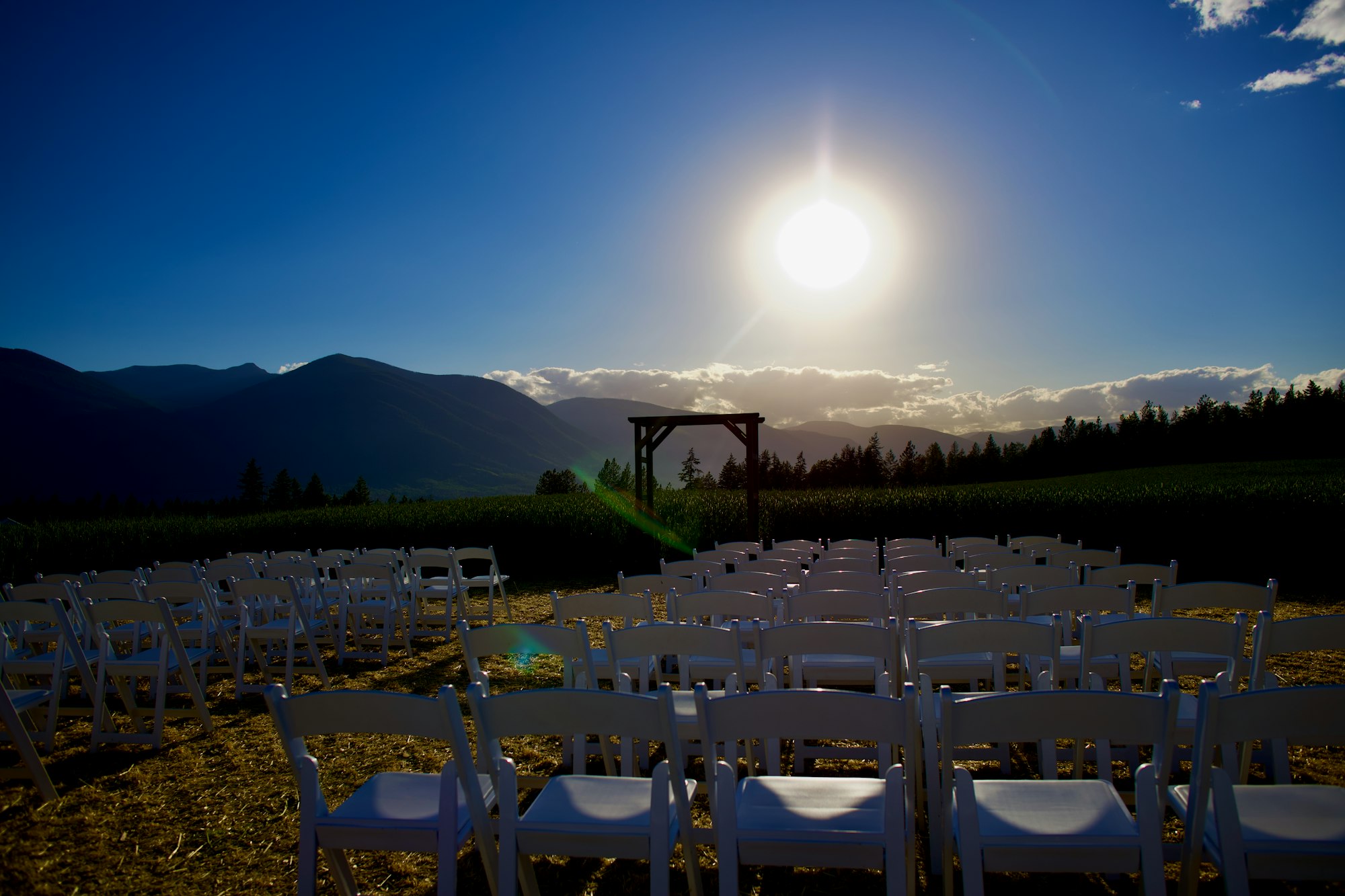
Copying a start time from another couple's wedding costs you the light. What time your wedding ceremony should start depends on sunset on your own date: begin about three hours before the sun goes down, then type an end time so the night still finishes when your venue needs it to. In Sydney, sunset moves three hours and eleven minutes across the year.
Sydney sunset, the shortest day against the longest.
What borrowing somebody else's start time costs
The sun sets in Sydney at 4:54 PM on 21 June 2027 and at 8:05 PM on 21 December 2027, a swing of three hours and eleven minutes, with usable light for about another half hour past each.1 A 4:00 PM start is a summer wedding with the whole evening ahead of it, and a winter wedding photographing the families in the dark.
There is a step in that curve too. Sunset on 20 September 2027 is 5:50 PM and on 20 October it is 7:12 PM, because daylight saving begins in between.1 Most Australian weddings land in that window: the most popular date of 2025 was 25 October with 2,035 marriages, then 22 November and 1 November, and 45 of the top 50 dates fell on a Saturday.2
So look up sunset for your own date first. Every other row on the day is worked back from it.
Which time do you already know?
You are rarely choosing from nothing. Something is usually locked, and the run sheet generator will back-solve the ceremony from it if you leave the ceremony field blank. It checks the other anchors in a fixed order: getting ready first, then the canape hour, then the reception.
| What is already locked | Where the ceremony lands |
|---|---|
| A church slot or a celebrant booking | That is the time. Nothing to decide. |
| Room access for getting ready | getting ready plus 4 hours |
| The canape hour | canapes minus 1 hour |
| The reception start, from the venue contract | reception minus 3 hours |
| Nothing at all | the builder assumes 3:00 PM |
Australian law will not settle it for you. The rules cover the Notice of Intended Marriage at least one month and no more than eighteen months ahead, two witnesses, an authorised celebrant and specific words said out loud. None of those rules mentions a time of day.3
Three locked times, all landing on one 5:00 PM ceremony.
Back-solve your own Put whichever time you already have into the run sheet generator, leave the ceremony blank, and read what it proposes.
The test: 3:00 PM against 5:00 PM on the same day
Method: one Sydney venue, Saturday 20 November 2027, sunset 7:41 PM and the light gone by 8:08 PM.1 Both columns come out of the generator from a single typed ceremony time, with every other field left blank, so the only difference is that one number.
| Row | 3:00 PM ceremony | 5:00 PM ceremony |
|---|---|---|
| Getting Ready | 11:00 AM | 1:00 PM |
| Leave for Venue | 2:15 PM | 4:15 PM |
| Guests Arrive | 2:30 PM | 4:30 PM |
| Ceremony Begins | 3:00 PM | 5:00 PM |
| Family Photos | 3:30 PM | 5:30 PM |
| Couple Introduced | 6:00 PM | 8:00 PM |
| Dinner Served | 6:45 PM | 8:45 PM |
| Speeches | 7:30 PM | 9:30 PM |
| First Dance | 8:30 PM | 10:30 PM |
| Send Off | 11:00 PM | 1:00 AM |
Sunset at 7:41 PM lands eleven minutes into the speeches on the left, and nineteen minutes before the reception opens on the right. With a 3:00 PM ceremony the couple are sitting indoors through the best light of the day. With a 5:00 PM ceremony they are outside with nothing booked, because the gap between the family photographs and the reception is the only part of a derived day with nothing scheduled in it.
Run the same arithmetic on every hour from one o'clock to seven and only two of them work: sunset falls in that free gap when the ceremony starts no more than three hours and no less than fifty minutes before it.
Start about three hours before sunset. On 20 November that is 4:41 PM, so call it 5:00 PM. On 21 June it is 1:54 PM, so call it 2:00 PM. The same rule gives you both, which is why it still works when your date moves.
Buying the light without losing the night
The 5:00 PM column does have a cost, at the bottom of the table: a send-off at 1:00 AM. A derived day ends five hours after the reception opens, and most venues will not let a night run that long.
One more typed field fixes that. An end time is used exactly as you type it, as long as it falls after the reception has started, and the rows in front of it pack in behind. Put 11:30 PM in and the same 5:00 PM day keeps dinner at 8:45 PM, speeches at 9:30 PM and the first dance at 10:30 PM, then finishes half an hour before midnight.
An 11:30 PM end time pulls the send-off back an hour and a half.
You type two times, the ceremony and the end, and the ten rows in between work themselves out around the light.
Do this in a live schedule rather than a document, because your ceremony time will move at least once and every row above and below has to move too. Change the one field in the run sheet and each supplier opens the same link to their own rows, already updated. It is a one-off cost rather than a subscription.
Common questions
What time should the ceremony start for sunset photos? About three hours before sunset. That puts the family photographs in soft afternoon light and leaves the couple free and outside when the sun is actually going down.
Is 3:00 PM a good ceremony time? It is what the builder assumes when you type nothing, and it works for roughly half the year. From October to March in Sydney, a 3:00 PM ceremony puts the best light of the day during the speeches.1 Read the full 3pm day before you commit to it.
How early should guests arrive? Thirty minutes before the ceremony, which is where the generator places the row. That is long enough to seat everyone without the front rows sitting waiting.
Does a morning ceremony work? Yes, if the reception is lunch. A morning ceremony with an evening reception is a harder problem, and it depends on how long you leave between the two.
Do we have to decide before booking the venue? No, and most couples cannot. Book the date, look up its sunset, then set the time. A venue contract usually locks the reception, and the ceremony back-solves from it at minus three hours.
What if we change the time later? Twelve rows move with it. In a document you retype each one and send the file again. In a derived schedule you change the ceremony field and the rest follows.
The shortest path from here
- Look up sunset for your date and your city.
- Subtract three hours. That is your ceremony time, to the nearest quarter hour.
- Check it against anything already locked - the celebrant, the venue contract, the curfew - and let the locked time win.
- Type the ceremony and the end time into the run sheet generator and leave every other field blank.
That takes about ten minutes, and every decision after it has a fixed clock to work from. The rest of the tools run on the same times.