How Long Does a Wedding Ceremony Take?
How long does a wedding ceremony take? Australian law sets no minimum and no maximum, so the length is whatever you and your celebrant put in it.
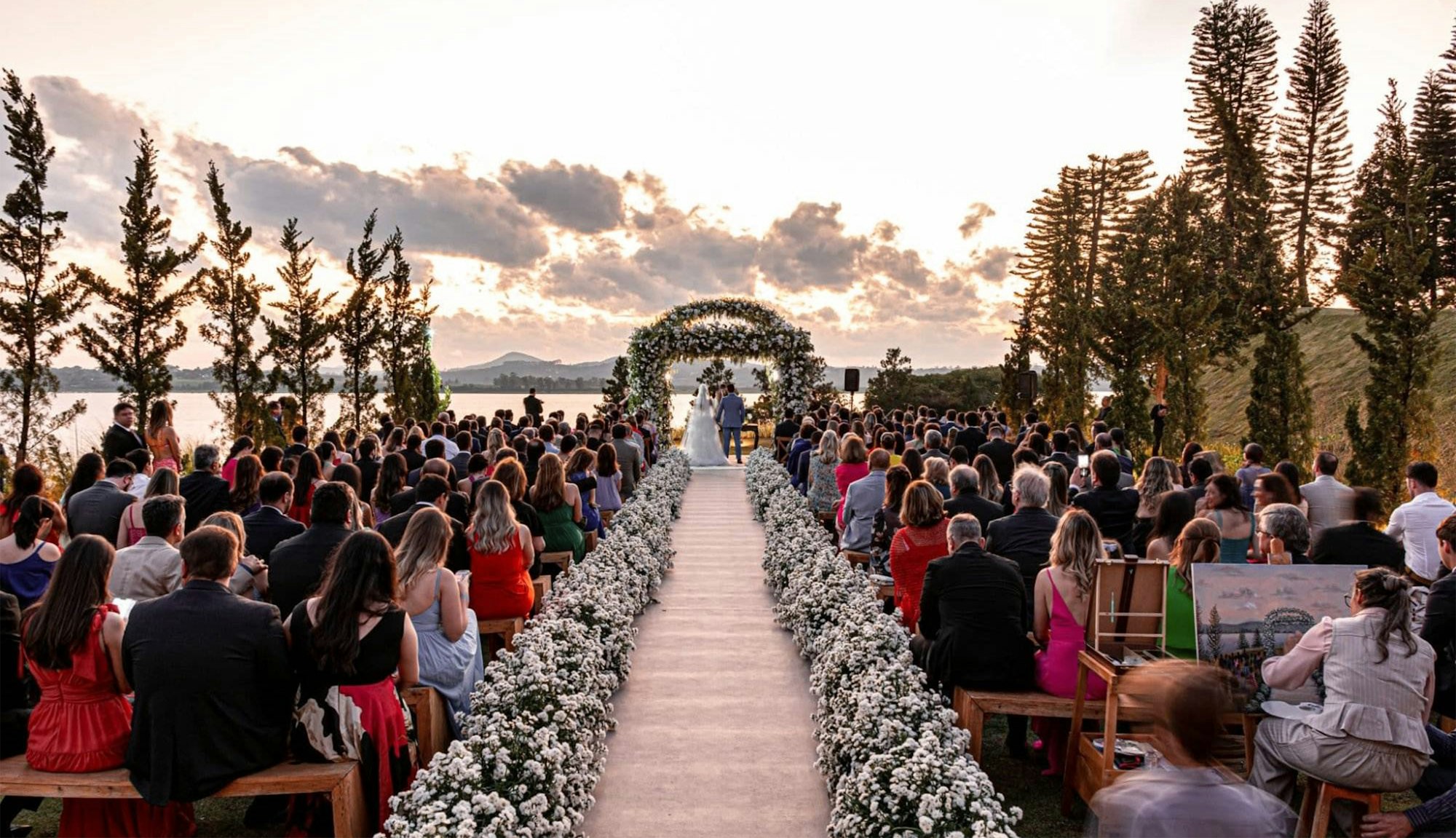
There is no standard length, and the figure in your head came from somebody else's day. How long a wedding ceremony will take is a decision you and your celebrant make: the Marriage Act sets no minimum and no maximum, and the content it actually requires is three sentences from the celebrant, one line from each of you, and the signing.12
The shortest legally complete ceremony in the country, and the floor for every longer one.
What the law actually asks for
The celebrant speaks first. Before either of you says anything, they say the monitum, three sentences setting out what marriage means under Australian law, and then each of you says a set form of words, or words to that effect.1 A minister of religion is exempt from that wording and follows the rites of their own religious body instead.1
Around those words sit conditions, none of them about the clock. An authorised celebrant has to be physically present, at least two witnesses over 18 have to be there, and a marriage may be solemnised on any day, at any time and at any place.2 On the day, three marriage certificates are signed by the couple, the celebrant and those two witnesses.5
No duration appears anywhere in it. The NSW Registry, which performs complete legal ceremonies all day, tells couples the ceremony itself takes between 10 and 20 minutes and asks them to arrive at least 15 minutes before their allocated time.4 Treat that as the floor for your own day rather than the average. A registry ceremony carries no processional, no readings and no music, so a ceremony you design yourself runs longer by exactly as much as you add to it.
So what adds the time?
Everything a guest would recognise as a wedding. Put the required parts next to the chosen ones and the shape of your own answer appears.
| Part of the ceremony | Required by the Act | Who sets its length |
|---|---|---|
| Seating the guests | No | Your run sheet |
| Processional and its music | No | You and your musicians |
| Welcome and acknowledgement of country | No | Your celebrant |
| The monitum | Yes | Fixed wording, three sentences |
| Readings | No | Whoever is reading |
| The words you each say | Yes | Fixed wording, or words to that effect |
| Rings and any ritual | No | You |
| Signing the three certificates | Yes | Two witnesses, one table |
| Photographs of the signing | No | Your photographer |
| The recessional | No | You |
Three rows in that table are fixed by law and the rest is a running order you commission.15 Which makes the honest answer to how long your ceremony takes a two-step one: ask your celebrant for their order of service, then count what you have chosen to put in it. Four readings and a live musician between each is a different ceremony from a signing and a song, and no average covers both.
The hour the day reserves around it
Your suppliers care less about the length than about the two edges of it. In a derived run sheet the guest-arrival row sits 30 minutes before the ceremony and the family photographs sit 30 minutes after it, so an hour of the day is already spoken for before anyone has decided on a single reading. The Registry works to the same shape at a smaller scale, calling couples in 15 minutes early.4
A derived day reserves the half hour either side of the ceremony before content is chosen.
That hour is the number to hand your photographer and your celebrant, because it is what they are actually pricing and staffing. If the order of service comes back longer than the slot, move the family photographs rather than the arrival time. Guests who sit down 30 minutes early and then wait another 20 have been standing in a car park since lunch.
Put the ceremony time in and read the rest of the day back The run sheet generator takes one ceremony time and places the arrival, the photographs and every row after them on a real clock.
How long before the day do the papers have to be in?
The other version of this question, and the only one Australian law does answer with numbers. A Notice of Intended Marriage has to reach your authorised celebrant not earlier than 18 months and not later than 1 month before the date of the marriage.3 The Attorney-General's Department publishes the same window in plain terms.5 A prescribed authority may allow shorter notice in prescribed circumstances, so the one-month edge is not fixed in the way the eighteen-month one is.3
The lodging window: not earlier than 18 months out, not later than 1 month.
Whatever running order you land on, the ceremony start is the field the rest of the day hangs off. Move it by twenty minutes in a document and every row below it needs retyping and re-sending. Move it in a live run sheet and each supplier opens the same link to their own updated rows, for a one-off cost rather than a subscription.
Common questions
How long is a registry wedding ceremony? Between 10 and 20 minutes at the NSW Registry, with arrival at least 15 minutes before the allocated time.4
Is there a legal minimum length for a wedding ceremony? No. The Marriage Act sets the words that must be said and the certificates that must be signed, and says nothing at all about how long any of it takes.1
Can we get married at 8:00 AM, or at 10:00 PM? Yes. A marriage may be solemnised on any day, at any time and at any place.2 Which hour works for you is a question about light and suppliers instead, and it is answered in what time your ceremony should start.
How long should we tell guests to allow? Ask them for 30 minutes before the start, which is where a derived run sheet puts the arrival row. Give them a finish time too, because the gap before the reception is the part they will plan their afternoon around.
Do the witnesses and the signing add much? Three certificates are signed on the day by the two of you, your celebrant and two witnesses over 18.5 The signing is a table and four signatures. The photographs your guests take of it are the part that stretches, so give the run sheet a row for them.
What if our celebrant is a minister of religion? The set form of words does not bind them, and the ceremony follows the rites of their own religious body.1 Its length comes from that order of service rather than from the Act, so ask for it early.
The one thing to do today
Email your celebrant and ask for their order of service with a start time and a finish time on it. That reply turns the ceremony from a guess into a fixed block, and every row after it can be placed against a real clock: photographs, travel, canapes, the couple walking into the reception. Put both times into the run sheet generator and let the rest of the tools work off them.